Saturday, June 7, 2014

Nickerson Beach in Summer

Summer. Spring migration over. Waterfowl season in winter over. Fall migration not here yet. Now is the time when all the birders on Long Island head to Nickerson Beach.

The birding started even before I arrived at Nickerson. Before I had arrived, I had already seen at least twenty Ospreys. Ospreys were in the air, in their nests, on poles, fishing, eating, and doing everything else possible. In short, Ospreys were everywhere.

Osprey

But arriving at Nickerson I found even more than Ospreys: twenty Black Skimmers were resting in the parking lot. Mixed in were a few Laughing Gulls, Common Terns and even an American Oystercatcher. How often are you able to pull into a parking lot and grab four life birds in five minutes?

Black Skimmers

Seeking more, I took out the scope and walked down a conveniently laid down blue mat to the actual beach. I had heard that Piping Plovers were nesting here, and I therefore read with interest a sign declaring that the territory behind was a protected nesting area for the plovers. Apparently, all plover nests are fenced in to protect it from predators, but the holes in the fence are big enough for the birds to comfortably go in and out. And so there was the answer to my question about what those little fences were for: inside the nearest one, only thirty feet away, sat a PIPING PLOVER on a nest! 

Now please understand that a picture of a Piping Plover does not fully express how charming a Piping Plover actually is. The more is so much more real in life, so much more active and interesting. So it's totally worth it to try to go see one.

Piping Plover

After seeing a Piping Plover, I continued down to the Common Tern nesting that has earned Nickerson so much fame among birders and photographers. And it was just as I had heard: terns all over, sitting on their nests, standing around, preening, commuting back and forth from the sea with fish. When the terns were occasionally disturbed, they would rise up in the air along with Black Skimmers, calling loudly, and their sheer numbers would make the sky appear white. American Oystercatchers were also there, and they had a very, very cute baby with them, picking at the sand and walking around. 

Common Tern on nest

American Oystercatcher chick

I turned back up the beach and headed back to the parking lot to attempt to photograph the skimmers skimming in the water again. Alas, upon arriving there, I found that the skimmers were not skimming with the same vigor that they had been before. However, I did get a few half-decent shots of them, a juvenile Laughing Gull, a Common Tern and a rare bird that had been reported hanging around Nickerson, a GULL-BILLED TERN making a brief flyover and a Glossy Ibis landing in the pond.
Gull-billed Tern

And that was that for the day, except for a quantity of Boat-tailed Grackles by the highway. A fine day of birding!


Sunday, May 25, 2014

Alley Pond in Spring

Alley Pond is a really really hot spring migration spot. Located in Queens, it is, in the words of the New York State Department of Environmental Conservation (NYSDEC) "The gem of northeastern Queens."

Arriving at the Upper Alley Woodlands, listed on eBird as having 209 species, I didn't find anywhere near 209 species, but I did find closer to 2,009 people throwing footballs, barbecuing and admonishing their children or, in some cases, totally ignoring their offspring. I should have known that this would be the scene on Memorial Day Weekend, but I dove into the woods anyway, and even though a large family blasted music as loud as possible, a Great Crested Flycatcher, a lifer for me, was very cooperative and gave me great views. A Baltimore Oriole sat in a tree and preened.

After hopping over a fallen tree, I found myself at a little kettle pond, where a Northern Waterthrush hopped around some logs on the edge of the water and a female American Redstart put on a show less then ten feet from me. Birds were abundant and very close up. Unfortunately, so were mosquitoes. After I smacked and scratched myself numerous times, I exited the area and returned to the main path.

Kettle Pond 

Northern Waterthrush

I then retired to the car, grabbed some water, and then got out again. Moving to a different area of woods, I found basically nothing except a Red-bellied Woodpecker nest, which was very active and fun to watch, as the parents went in and out of the hole in the snag with food.

Red-bellied Woodpecker Nest

I moved around a bit, and there located even more Red-bellied Woodpeckers, and also a Hairy Woodpecker, which was a nice treat. There were also Gray Catbirds--the male was trying to get a female to mate--a bunch of Baltimore Orioles, and and a troublesome flycatcher that may have been either a Willow Flycatcher or Alder Flycatcher, or may have been neither. But a bright male Scarlet Tanager was really beautiful.

Scarlet Tanager

Finding little else than a House Wren at the Upper Alley Woodlands, I decided to head over to the Alley Pond Environmental Center, a nature center built to educate urbanized Queens kids, and also the headquarters of the Queens County Bird Club, my bird club. 

Upon arriving there, I found another birder setting up a giant camera in the parking lot. He provided me with some fantastic tips, and so I set off into the woods. 

The other birder had told me that there was a Willow Tree a little down the path that often held Yellow Warblers and Blue-winged Warblers. I found it in only a moment, and sure enough, with a flash of yellow, there it was, my old sight nemesis, the Yellow Warbler. Those birds must not like me; I have heard them all over the place, including in my own backyard, but never seen one. But on this day at APEC those bright little birds were very cooperative.

Yellow Warbler
I kept down on the path, where there was a female Red-winged Blackbird and a bunch more Yellow Warblers and plenty of Baltimore Orioles. 

Moving down a wood walkway through a marsh, I encountered two pairs of LOVEBIRDS, not the feathered ones but the human types, an adult pair and a younger pair. Both stood there and did some stuff, which I am going to skip over.

I passed the lovebirds and came out to an overlook that surveys a marsh and some water. I there found the other birder, who gave me some more good tips, but I also found Tree and Barn Swallows, zipping around and occasionally perching on nest boxes. A Red-tailed Hawk soared way off in the distance and then disappeared, not phasing the Mallards on the water. A Great Egret flew across the the marsh and landed next to a Black-crowned Night-Heron.


Great Egret and Black-crowned Night-Heron

The sun was setting, a Red-winged Blackbird yelled at me because, well, I don't know, and a Song Sparrow sat on a branch. I looked around a little bit more and a male American Redstart sang happily. 

American Redstart
And then I left. I had gotten two lifers and a bunch more on my year list, and some great photos. It was late, I was hungry and tired, but thrilled to have seen such great birds!

Barn Swallow


Saturday, May 10, 2014

QCBC Big Day

Every year, bird clubs around the country get a bunch of people together and send them to count all the species they see on a certain day, usually May 10. The Queens County Bird Club (QCBC) is no exception. I was thrilled to be able to participate.

I arrived at Forest Park, where the count was to take place at around 11:20 AM. And from there, I took off into the woods, going down a concrete path known as the Park Road, but then diving into the real woods. There, I found plenty of birds: Black-throated Blue Warblers, an Ovenbird, and Northern Parulas, all three lifers. As I watched a parula only around eight feet from me, the flashily colorful bird took off and headed straight for my head. It dove only around one foot away from me; I literally head to duck to avoid being hit in the head by the new, high-tech  PARULA MISSILE used by the US military. 

Black-throated Blue Warbler (photo by Lauren Scott)
We finally arrived at the Waterhole, an area where birders set up a feeding station in the winter and floods to make a swampy pond in the spring and summer. This is one of the best birding spots in Queens, at least in spring migration.

I there joined up with the rest of the Big Day team. High above us, a Scarlet Tanager, a lifer for me, landed in a tree, drawing plenty of attention from fellow birders. A Yellow-rumped Warbler landed on a log. 

According to Jean, the leader of the team and a frequent birder in Forest Park, a rare bird had been hanging around and we had to find it. We heard it sing all day long, the unmistakable two part "chip...eeeeee!" of the BLUE-WINGED WARBLER. We heard it, we chased it, we stared into the trees with binoculars, but we never saw it. But since we all heard it, we added it to our total count. 

While chasing that Blue-winged, I was delivered some other birds: a Red-eyed Vireo, Magnolia Warbler, American Redstart, Wood Thrush and Veery. 


We decided to move on to another area. But before we do so, we get a few more birds: a BROWN CREEPER, a bird that hangs out here in the winter but not so much in the spring. We were ridiculously excited to see it. Also, a Northern Parula splashing in the Waterhole, taking a refreshing bath, a Swamp Sparrow, and a skulking waterthrush that we'll just call Waterthrush sp. (P.S. That's a euphemism for "I couldn't identify it).  Just before we left, we located a Palm Warbler.
Northern Parula (photo by Lauren Scott)

Northern Parula (photo by Lauren Scott)
Next, we moved on to another part of the park. While waiting for the rest of the team to arrive, I peered into a little gully called the Kettlehole, and was, in the space of five minutes, showed three Wonderful Warblers: the Blackpoll Warbler, Blackburnian Warbler and Canada Warbler. Also the Red-eyed Vireo showed itself nicely. A little bit down from there I located a Black-throated Green Warbler preening in a tree.

I joined up with the team and headed down a trail. Alas all we located there were three Baltimore Orioles. Heading back down the trail to grab some food, I located a Black-and-white Warbler and a 
Common Yellowthroat.

After getting food, we headed back into the park, only to find the trip leader Jean waving us down frantically. I ran (literally) down to her, and found that they had a MOURNING WARBLER, a really really big rarity. Unfortunately, only one of us saw it, though we spent twenty minutes trying to relocate it. 

In that time, it started to rain.

And it got worse.

In ten minutes, the rain was pounding down constantly. It was so loud, I couldn't hear any of the singing warblers that we had seen. However, this also had to do with the fact that all the birds in the place had hunkered down and shut up. They were gone. I wasn't wearing a coat, just my t-shirt and lightweight pants (it had been eighty-one degrees. It was now sixty-eight degrees and raining). At least my binoculars were getting cleaned.

The rest of the team, three people, had left their car far away, and had to get to a place where they could hold food. We ended up driving them: five people in a car that can hold four. But they got there and I got home, to write this blog post.

Take a look at my total life bird count for the day, just to give you an idea of what a fantastic day it was.

  1. Swamp Sparrow
  2. Red-eyed Vireo
  3. Magnolia Warbler
  4. Northern Parula
  5. Black-throated Blue Warbler
  6. Black-throated Green Warbler
  7. Veery
  8. Wood Thrush
  9. Canada Warbler
  10. Blackpoll Warbler
  11. Scarlet Tanager
  12. Ovenbird
  13. Blue-winged Warbler
  14. Yellow Warbler
11:30 AM to 3:15 PM and fourteen life birds. Now there's a fine day for you. Lots of thanks to the trip leader and the other birders who helped me out.

Black-and-White Warbler (photo by Lauren Scott)


Saturday, May 3, 2014

Clark Botanic Gardens: Spring Migration

Spring migration! The favorite time of year for many birders! I went today to Clark Botanic Gardens, near my house, to attempt to locate birds on spring migration.

First bird of the day was heard, a Pine Warbler. Gosh, that bird really had plenty to say. On and on it went, singing its rising, trilling song, all day long. However, the bird never showed itself so I could take a picture of it.

As I stood there vainly searching for a Pine Warbler to photograph, a fantastically beautiful bird, a BALTIMORE ORIOLE, flew over my head, landing in a tree. It was a bright adult male in full breeding plumage. Every year these male orioles come a few weeks before the females, in order to get nesting territories straightened out. However, this pair of orioles has nested alone in the garden for many years, so the male oriole just hangs around and sings loudly and acts flashily. Pretty soon, the female will come and then we hope they'll get about nesting.

A Baltimore Oriole has something to say
I then walked down by one of the three ponds at Clark. Looking into the trees, I got the best bird of the day: a BLACK-AND-WHITE WARBLER, a bird I'd longed to see. This little guy is a small warbler with black and white streaks, and he hitches up and down the tree like a nuthatch. Some Ruby-crowned Kinglets also bounced around in the trees, my FOS.

Black-and-white Warbler
Walking down to another grove of pines where I'd seen a Blue-headed Vireo the day before, I found it strangely empty. Soon, though, I encountered the reason for the emptiness: A Sharp-shinned Hawk gliding off the trees and hovering into the air, looking for prey. However, it was awfully dark, and I couldn't get a good picture.

It had been good birding, and it was time to finish up. More Black-and-white Warblers acted like nuthatches as they should, and another Ruby-crowned Kinglet flitted around. A Chipping Sparrow sat in a tree.
Chipping Sparrow
Black-and-white Warbler

And that was it, a fine day of spring migration, and I added some birds to my life and year list.
Yet another Black-and-white Warbler


Saturday, April 26, 2014

Happy Birthday Audubon!


Today, April 26th, 2014, marked John James Audubon's 229th birthday. Needless to say, this is a very important occasion. Without Audubon, it is certain that certain birds that are here today would be extinct. The world, especially the birding world, would very, very different today without Audubon.

In order to celebrate this important anniversary, I went birding. The best way to celebrate anything.


First stop was Muttowntown Preserve. I had received an email saying that was a Red-headed Woodpecker hanging around the nature center there. So, I went.

I pulled in to the parking lot, strapped on my binoculars and stepped into the woods, walking down the trail. Nothing showed.

Finally, something showed: another birder. I knew he was a birder because he was wearing binoculars on a chest harness similar to mine and a camera with a giant lens. I walked over to him and asked him the typical birding question: "Do you have anything?" He whispered back, "Red-headed Woodpecker."

And so I looked, and there was no question about it. The bird, unmistakeable with it's deep crimson head, thrilling white back, jet black back, and, when it flew, white patches on black wings, was a RED-HEADED WOODPECKER. This bird most certainly earns the caps and bold type, as it is not only a beautiful bird, but also now a threatened species, thanks to (of course) humans and their disgusting behavior.
Red-headed Woodpecker

Muttowntown didn't offer much else, except a lone Canada Goose sitting on her nest on an upturned root in a pond. That was nice, but I wanted to move on. 

Canada Goose Nest

And then it was off to my favorite birding spot of all, Tappen Beach. It started before we got to the beach: both Ospreys, were on their nest. They should be ready to lay eggs pretty soon, but for now, I was just thrilled to see them at their old haunts. 
Tappen Beach Osprey Nest

Osprey Close-Up

I pulled over at another nest, this time a Peregrine Falcon nest. This nest is sitting on the smokestack of an abandoned power plant. Stupidly enough, numerous pigeons live and nest right next to the falcons. This is a fantastic grocery store, always stocked, for the nesting falcons. Now, one falcon swooped away, but the other, probably the male, had a pigeon he had procured from the downstairs grocery store and was plucking it. The feathers were flying all over, surrounding the eating falcon and settling on the road. He flew before I could get a picture, but then settled down on his nest, and allowed for some photographic time. 


And then, Tappen Beach itself. It was, unfortunately, dead, except for a bunch (39, to be exact) Brant.

We tried to go down by Duffy's Bait and Tackle, but that, too was dead, with the exception of a few Song Sparrows, Ring-billed and Herring Gulls and a nice view of the two Ospreys on their nest. 
Ospreys on Nest
And that was it. I went home. But not sadly, as I had seen plenty of birds, including the Red-headed Woodpecker which was a lifer. And so it was fine birding for the celebration of John James Audubon. 

Red-headed Woodpecker in flight


Saturday, April 12, 2014

Tappen Beach, Spring is Here!

I visited Tappen Beach to photograph gulls for a photo essay I'm working on about them. But, as always, I ended up birding.

First bird of the day: Osprey! Two adults were on their old nest on a cell tower. I can't wait for the eggs to be laid, thus beginning the new season of monitoring my Tappen Beach Ospreys!
"Hi! You're back to watch me lay eggs!"

Next, I just walked around and photographed gulls, down by the lookout. Some Buffleheads hung around in the middle of the inlet. Then, after really, really concentrating on two Herring Gulls to photograph, I walked down to the car. Lo and behold! A Killdeer flew in front of me and landed on the sandy beach! Lo and behold! It was simply a Mourning Dove that chose to forage on the beach! So much for that Killdeer.

Here are some of the fantastic (not bragging) gull photos I shot today.


Great Black-backed Gull scarfs down a giant fish

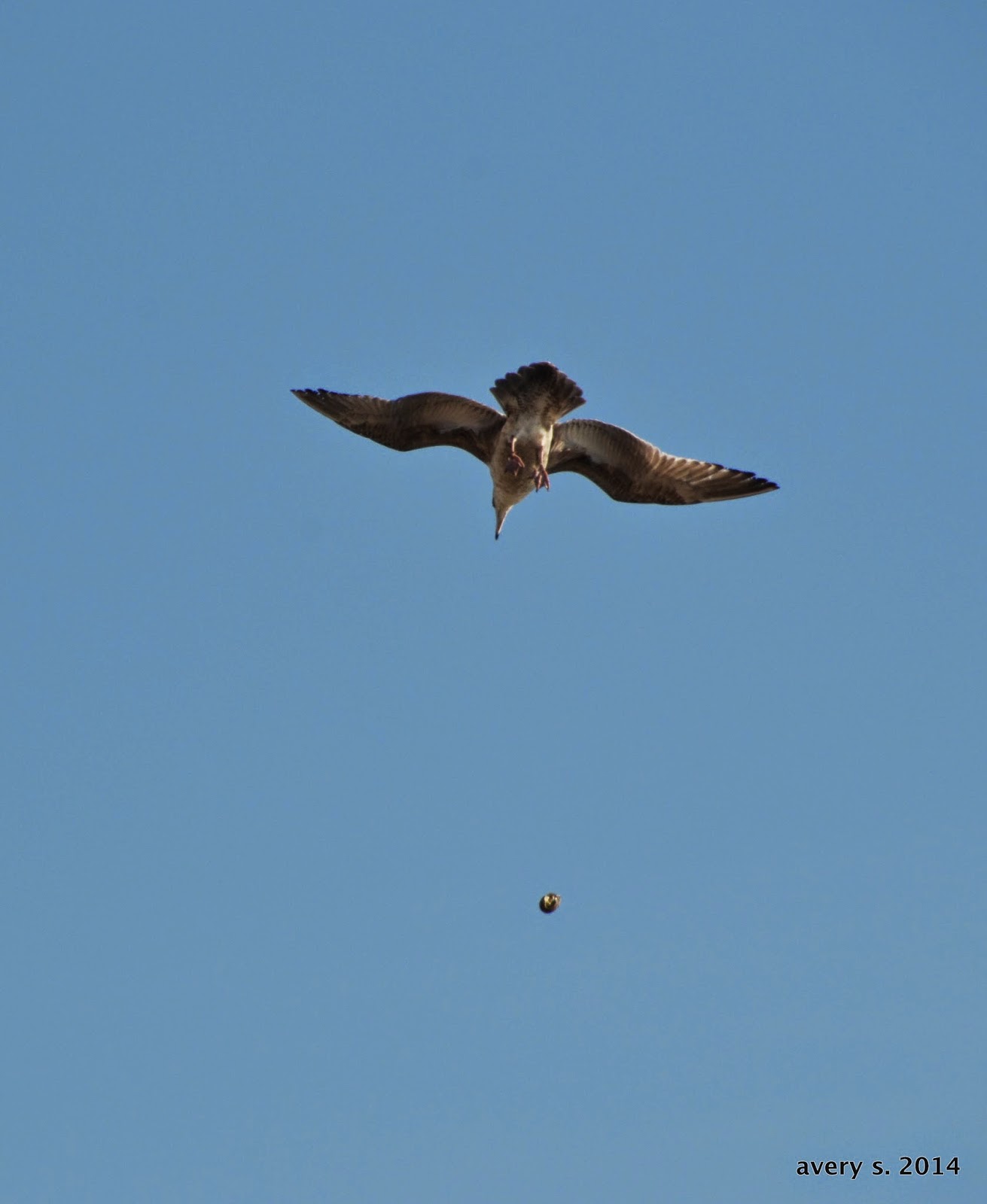
Herring Gull dropping food to crack shell

"Don't worry! I"ll get it!" 

B&W Ring-billed Gull
Down on the sandy beach, as I photographed the Great Black-backed Gull swallowing a fish, I flushed some Brant. They flew around the inlet, and then came back to land right next to me. I aimed the camera at them, and held down the shutter. Take a look at what I got.
Brant landing

On the way back, I decided on a whim to take a stop at Duffy's Bait and Tackle, where I walked down a disgustingly dirty ramp that ran down to the water. After I got there, I was disappointed, seeing only Canada Geese and Mallards

Soon, though, there was much more than that. My mom said, "there's an egret, or a heron. It's too small to be an egret." I raised my binoculars. Could it be? I raced back to the car and and grabbed the scope. Aiming the sight tube at the little white wader, put my eye up to the eyepiece, twiddled the focus wheel, and then my heart thrilled as the scope filled with the image of an adult SNOWY EGRET in full breeding plumage. Not only was it my FOS, but it was my 101st lifer!
Snowy Egret

I put the scope back in the car. As I did, my dad pointed out to me that there was a "small diving bird" in the water. I looked out with my binoculars, and saw something that mildly resembled a loon. Of course, I now had to get the scope again. I did. The diving bird stayed underwater, but when he popped up, I quickly aimed the scope at him and looked through. What I found was an extremely close view of the Red-necked Grebe that has been hanging around for a while. It was a very, very close view, no more than 50 feet away from us. I could see him well enough to notice that he had some feather tufts on his head, just coming into breeding plumage. I could also notice the remarkable resemblance to the illustrations in Peterson's Guide; in fact, if I had seen the illustration next to the bird, I would have though I was having double vision.

It was a great day of birding, and brought me some fantastic photos and a lifer!


Sunday, April 6, 2014

Oyster Bay in Early Spring


Today, I birded some areas in Oyster Bay, Long Island, to try to get a last glimpse of waterfowl before spring came, whereupon I would be engrossed in warblers flitting through the trees at ridiculous speeds and struggling to tell the two dowitchers apart.

I started out at Theodore Roosevelt Park, which seemed to be an extremely attractant for young romantic couples. I was not interested in romance. I was interested in the Ospreys soaring over the water and parking lot, and generally being beautiful birds. Numerous Bufflehead and a lone Double-crested Cormorant floating out there. Ring-billed and Herring Gulls grabbed food from the parking lot, and four female Hooded Mergansers hung out by the piers.

The best bird at that place were four Long-tailed Ducks floating and diving way out. Soon, I knew, they would be heading north, starting to breed in small arctic ponds on the tundra. I felt thrilled to see them before they took off, heading north.

Bufflehead

Next, it was Mill Pond. And it was good, better than the beach. More Ospreys circled over our heads, and more Buffleheads swam and dove in the water, but there was also a Great Blue Heron, resplendent in breeding plumage, and my FOS (first of season) Great Egret, its long tail plumes waving in the breeze.
Great Blue Heron

As many beautiful birds as we could see, The Bird of The Day was, or were, a large quantity of Tree Swallows swooping and diving over the water. They are fairly common birds in the spring, so why were they so exciting, you ask?

The reason is, as I stood, swinging my binoculars around wildly to follow the antics of those swallows, their blue-green backs reflecting the setting sun, I rejoiced and marveled at the fact that, in almost three years of birding, those Tree Swallows were the centuplicate bird, another avian diamond going about it's daily activities that had let me be privileged enough to witness it. 

There's another way of putting it. The Tree Swallow was my 100th Life Bird. 

And so we left, me having seen my 100th bird. It's always fine heading home after a great day of birding, and so I went contentedly into the car and let the pond slide away behind me.
Mill Pond


If anyone wants to hear something totally unrelated, two Mourning Doves have laid eggs in a nest in my backyard. I will make a post about that soon.
Double-crested Cormorant


Saturday, March 22, 2014

Hempstead Lake State Park: Spring is Here!

Spring is Sprung! The birds are singing! The flowers are blooming and the butterflies are fluttering!

I visited Hempstead Lake State Park today to locate signs of the arrival of spring. The first sighting came as we were driving there: a large, dark bird with crooks in the wings flying over us. 'Twas a first-of-season OSPREY! It should be pointed out that Ospreys are some of my favorite birds, thanks to their gray-and-white plumage, huge (six foot) wingspan, and stunning headfirst plunges into the water to grab some fish. And, every year when it gets chilly out and the snow is on the ground, all the Ospreys around pack up and head on down to Cuba. Not until spring do they return. Therefore, seeing an Osprey is really a sign of spring.

Then, I visited the South Pond. A raft of Ruddy Ducks swam around, and a large quantity of Hooded Mergansers did the same behind them. Numerous Ring-necked Duck mixed with the Ruddies.

Then, we headed toward the main lake, walking along the trail and making a few stops along the way. A great number of White-breasted Nuthatches hopped up and down the trees, making their nasal "hank, hank, hank" calls.

I observed the South Pond again, from the other side. Here, another Osprey circled around and hovered quite close, allowing for great photos.
Osprey Hovering

More Osprey
Then, we accidentally bumped into McDonald Pond, a tiny manmade body of water mainly for fishing. However, there was a pair of American Wigeon there, which was nice.
American Wigeon Pair
American Wigeon Posing for the Camera
A Cooper's Hawk soared around way up high in the sky, totally scaring the wits out of a series of European Starlings. It was good to see a Cooper's Hawk. I haven't seen one in a long time.

Then, we made a discovery: a pair of Red-bellied Woodpeckers attending to their nest hole in a tree! I'll go back and watch them with their young later on in the year. 
Red-bellied Woodpecker Nest Hole
I jumped a guardrail (don't tell anybody) and then was looking out over the Hempstead Lake. Ring-billed and Herring Gulls were out on the lake, with four Greater Black-backed Gulls mixed in. Another Osprey flew to my right, carrying nesting material. A Red-tailed Hawk flew across the lake, and landed in a tree. 

And then, there was a little loon out on the water. After much deliberation, I determined it was a RED-THROATED LOON, a life bird! I continued to see him throughout the day, and he much overshadowed the Tufted Titmouse in the trees. A Murder of American Crows sat in a tree.

A Murder of Crows
We headed home, but pulled off again at the South Pond. There was a most likely Common Loon, a Bufflehead, and yet another Osprey. Numerous swallows flew around, some of which were Barn Swallows and the rest of which may or may not have been Tree Swallows, but most likely were not.

The real find there was not a bird, though. It was a BEAVER, swimming low in the water and looking like a beaver generally should. 

It was a fantastic trip!

Totally unrelated to Hempstead Lake or the arrival of Spring, but I found out today that most of the pageviews on this blog come from the New York State Young Birder's Club website, where this site is listed as a young birder blog. Thanks so much for putting it there! Please check out their website, and if you are a birder who lives in NY between the ages of 10 and 19, consider joining!


Red-throated Loon Flaps Wings!


Sunday, March 16, 2014

More Tappen Beach Birding, and some Marine Mammals

I visited Tappen Beach again today. Then again, I could say that a lot of the time.

Either way, it was good. The first thing I found was a pair of Hooded Mergansers floating in Scudders Pond, across the street from Tappen Beach. Behind them, there were four Wood Ducks, and some Canada Geese were hanging around, one of them wearing an orange neck collar reading the code Y9R5. A Double-crested Cormorant was flying around.


Wood Duck


After that, over to Tappen itself, and there was a bird that was a Red-necked Grebe, my best bird of the weekend by far. For those who don't know, the Red-necked is the largest of our grebes in North America, with a distinctive white chinstrap in non-breeding plumage and a general demeanor and appearance that is quite loon-like. I continued to see him throughout the day. 

Some Red-breasted Mergansers flew in and floated around over by a big red-and-yellow boat called the "Deborah Quinn." Two Common Goldeneyes flew across the harbor, and a Hooded Merganser female flushed and landed in the middle of the wide, wide water, where she was joined by a male Bufflehead. Maybe soon we'll have some Buffleheaded Mergansers…?

My dad said, "Right where that that Bufflehead took off, there's a bird's butt sticking out of the water." I looked, but saw a grey lump that wasn't a bird's butt. Curious, I focused my scope. The grey lump had a black nose, two bright black eyes, grey fur and flippers. It was a SEAL! I have never seen a seal before, though I have been to various beaches many times.

Bufflehead

Further down, there was the Grebe again, and some Bufflehead, and numerous Gadwall, American Black Duck, and American Wigeon. 
American Wigeon


More Wigeons!

And finally, I returned to the car. There, six Brant floated around and braved the waves. 
Brant

I will Brave the Waves!

And then, home. But home happily, for it was a great day of birding.