Monday, January 26, 2015

The Birdy Site eBird Challenge!

If you live in the Northeastern United States, you are getting ready to face a humongo blizzard sometime tonight or tomorrow. In the state of New York, where I live, the governor has even banned all road travel from 11pm tonight onwards.

In other words, most of us are not going be going out birding tomorrow.

Instead, we will be stuck inside. What will we do?

I have a proposal. It is The Birdy Site eBird Challenge for the Northeast US Blizzard, January 2015. Your challenge: submit one complete eBird checklist a day each day you are stranded at home.

What do I mean by complete? Well, when you submit an eBird checklist, there will be a question on the last page that will look like this:


Put in all the birds you were able to identify, and then click yes. That is a complete checklist. 

Tell me in the comments two things: one, how many species you eBirded from your home over the blizzard and two, how many eBird checklists you submitted. Good luck! And whatever you do, have fun.
My eBird yard life list


The Birdy Site is on Facebook!

Yup, that's right. The Birdy Site has joined Facebook!


If you are on Facebook, please like The Birdy Site (you can do this above) and share!

Monday, January 19, 2015

New York State Waterfowl Count

January 19th, 2015, was cold and windy.

Unfortunately, it was also the day that I was set to do the NYS Winter Waterfowl Count. Organized by NYSOA, the count gets a general idea of what waterfowl are wintering in New York State.

I had been asked to help cover the North Shore of Nassau County, and had signed up to do the east side of Hempstead Harbor, a small inlet of the Long Island Sound. My goal was to cover from Roslyn to Glen Cove, a total of 7.6 miles.

The first stop was at the Roslyn Duck Ponds, two small ponds at the base of the harbor. Two merganser species, the Common and the Hooded, were present among the fifty Mallard, four Mute Swan, one Ruddy Duck and two American Coot. Otherwise, there was pretty much nothing hanging around (other than the ubiquitous Ring-billed and Herring Gulls), as the ponds were mostly frozen over.
Hooded Mergansers

Common Merganser

Next up was, interestingly enough, a senior center. Behind this senior center is a trail that runs along the water, offering great views of the harbor. Here there were ninety American Black Duck, four Great Blue Heron, and of course numerous Ring-billed and Herring Gulls. 

As I took a brief break from scanning the water, something black caught my eye. I got my binoculars on what looked to be a crow, but it was gliding, flying like a hawk. And then it turned.

The bird had a wedge-shaped tail.

COMMON RAVEN is by no means a common bird in my area, yet that is what this bird was. I relocated it at the next stop Cedarmere Preserve, and it flew right over my head and called. While it is an uncommon species, ravens have nested in the area in the past, so it was not totally unexpected. 

Common Raven. Terrible shot, I know.

Nothing else was at Cedarmere, so I headed up the road to Tappen Beach, my old wintertime patch, and found two Greater Scaup, a loon sp.,  and a pair of Bufflehead. Further up the beach were six Common Goldeneye, plus more American Black Ducks and Bufflehead.

Next up was Sea Cliff Beach, the site of the 2013 Black Guillemot. I found no guillemots, but I did see a Common Loon putting on quite a show, and eight Red-breasted Mergansers, giving me all the North American merganser species for the day.

Common Loon
The final stop of the day was Morgan Memorial Park, or rather the jetty there. However, by this time, it was so cold and so windy that any sort of optics were useless; indeed, it was virtually impossible to stand upright. The only good bird I picked up there before being blown back to the car and home was a Horned Grebe, just before the light darkened too much to see any further species. I hope to participate in this survey again in the future, though hopefully in better weather.


Great Blue Heron

Thursday, January 15, 2015

ABA Bird of the Year

Every year in January, the American Birding Association announces it's Bird of the Year. The Bird of the Year is a big deal as it represents the ABA for the year, not to mention being stuck on the optics of every ABA member around (the ABA sends out stickers with an illustration of the bird to all members).

Last year's ABA Bird of the Year stickers (this year's haven't arrived yet)

This year, the artist chosen to paint the ABA Bird of the Year was Rafael Galvez. He announced the species in a short video in English (below) and in Spanish. Take a look.


Also, the ABA has a badge that you can embed in your website with Mr. Galvez's beautiful artwork. Just click on it below and it will take you to a site where you can copy the HTML code and paste it to your own site.

ABA Bird of the Year

Friday, January 2, 2015

Snowy Owl: Nemesis No More!


As many of you readers know, in the winter of 2013-14, there was a massive irruption of Snowy Owls. However, try as I might, I did not get to see one; therefore, the Snowy Owl went on my nemesis bird list.

However, the winter of 2014-15 had arrived, and I had high hopes of getting the bird this year. Of course, finding decent numbers of Snowies was harder without an irruption. Nonetheless, I had been alerted to a Snowy present on New Year's Day.  On January second, I rushed out there to see it.

Before getting to the spot, I made a stop at Floyd Bennett Field, an old airport that was being well trafficked by birders due to a Cassin's Kingbird that had shown up there in November 2014. It was the second state record of this western flycatcher in New York State and seemingly the entire New York birding community had run down to see it.

I found the Community Gardens, where the bird had been hanging around, by asking directions from a very rude park ranger. (Actually, my parents did the asking, since I would have been to scared to approach this guy.) I hopped out of the car at the gardens and asked some other birders if it was still around. They said yes. I walked over, put up my binoculars in the direction some photographers were shooting, and saw it.
Cassin's Kingbird!

Having seen the second state record of Cassin's Kingbird, I headed down to a beach on Floyd Bennett Field. There, Brant, Canada Geese and of course the ubiquitous Herring and Ring-billed Gulls hung around near shore, but further out sixty Red-breasted Mergansers bobbed in the waves. One Song Sparrow in the parking lot seemed content to eat out of a dish left out for a feral cat, even though the cat was right there. A Bufflehead kept out to the water.

I headed back to the community gardens to look for Horned Larks, but first had to count the guys with giant lenses waiting for the kingbird. While they and their equipment searched the garden, the kingbird flew right in front of my car, causing my parents to exclaim loudly. It then sat obligingly in a tree ten feet from my window, allowing for great photos.

It was now time for my nemesis, the Snowy Owl. I headed to the place where the owls were reported to be and there met a kind ranger who informed me of the location of the owl--right behind a post on the beach.

Upon arriving at the beach, I realized that maybe finding this bird wasn't going to be as easy as finding a post and then looking behind it. There were at least twenty posts up and down the beach. So I just started checking every post.

The eight or ninth post had a lump behind it.

I have seen lots of pictures of these arctic owls, but seeing a SNOWY OWL in person is very different. The bird swiveled his head back and forth, looking around with calm but alert eyes. I moved back, in case I was scaring him, and he hopped up on top of the post, then flew a short distance and sat on the sand and preened. Some birders who said they were from Canada happened along and we all enjoyed views of the beautiful owl; the bird that was a Nemesis No More.


To avoid stressing the owl, we left soon. On the way home, I made a brief stop at Fort Tilden, a beach along the Rockaway Peninsula. Two Red-throated Loons bobbed in the waves there, another Red-breasted Merganser hung out by the shore, and a Long-tailed Duck dove under every few minutes. Other than that, nothing really happened, but there was a beautiful sunset to look at and I had fun photographing the waves as they pounded against the jetties along the shoreline. The last bird of the day was a Double-crested Cormorant flying north against the setting sun.


Monday, December 29, 2014

Christmas Break Birding: Episode 3

Christmas Break Birding
Episode #2
South Shore, Nassau County, NY

For this third and possibly final* episode of Christmas Break Birding, I decided to cover two ponds/lakes on the South Shore of Long Island.

First up was Massapequa Lake, a large lake on the southern end of Massapequa Preserve. Upon arriving the first thing that was evident was a large grouping of Ruddy Ducks, forty-five to be exact. A closer scope scan revealed innumerable amounts of Hooded Mergansers and American Black Ducks, with Mute Swans, Northern Shovelers and a Great Black-backed Gull mixed in with the Ring-billed and Herring Gulls. Some American Coot were also present, and while not rare, they do have unusually cute looks for any bird, not to mention lobed feet. I also located a bunch of Ring-necked Duck on the other side of the pond, though the Gadwall and Common Mergansers also present in the same vicinity did not seem interested in socializing. A Downy Woodpecker called from a nearby tree.

Further up along the trail that leads around the lake, a Black-capped Chickadee called incessantly, though it was almost drowned out by the calls of the exciting, amazing, super-rare House Sparrow. On the water, the ubiquitous Canada Geese and Mallards quacked and honked and made a ruckus. A Great Blue Heron flapped heavily across the water, landing on the other side of the lake in some reeds, where it proceeded to sit down and not move.

I had somewhere to be at 4:30 and it was already 3:00, so I moved back down the trail, where a Song Sparrow hid very well in the bushes, though I saw it anyway. 

I detoured along the way to the next stop and drove through Robert J. Burns park, which is situated next to a canal of the Atlantic Ocean. There was nothing at all there except nine Hooded Mergansers, all females, which provided great photo opportunities, as they were so close. Several Ring-billed Gulls were also very close to the car, which allowed for good shots.

The final stop of the day was a place called Unqua Lake, where one had to be careful where one stepped so as not to tread upon Canada Geese and Mallards. My counts, as reported to eBird, were 200 for the former and 150 for the latter. However, there were a bunch more American Black Ducks and Hooded Mergansers, as well as two Northern Shovelers and a nice surprise in a tree across the lake, two Black-crowned Night-herons. 

Speaking of night, the sun was setting, and I had an appointment. Enjoy the day's photos!

*I say final tentatively, as I have no further plans for birding over Christmas Break, but am prone to SBI (Sudden Birding Impulse).

Ruddy Ducks

Gadwall

Common Mergansers

I guess she took off...

The Ladies Club--Hooded Mergansers

"I see you looking at me..."

Common birds are beautiful too!

Incoming!  Canada Geese

Sunday, December 28, 2014

A Look Back (on 2014) and Forward (to 2015)

As I write, there are three days left in 2014. With the year drawing to a close, I feel the need to sum up 2014's birding and give a preview of 2015.

This has been, without a doubt, my most serious year of birding yet. I have gone birding too many times to count, participated in several large birding-related festivals/conferences, and gotten seriously into this blog, writing a total of twenty-two posts since January 1, 2014.

I have, as I intended, done lots of eBirding, with exactly 45 checklists as of the writing of this post. I am planning on keeping it up into next year, on a quest to get to the top five Nassau County eBirders.

Right now, my year list for 2014 stands at 114. However, I have three days, and would like to add a few more before the end of the year.

In 2015, I am attempting a very leisurely, relaxed Big Year. Most big years are limited to county, state, Lower 48 or North America, but I am going to try a Big Year in Suffolk, Nassau, Queens, Kings, Richmond, New York and Bronx counties. I will probably not cover some of these counties, but I include them because I would hate to see a bird by accident in one of aforementioned counties and not be able to count it on my Big Year total.

The areas I'll be covering in my 2015 Big Year

I know of one NYC Big Year that reached 307 species, and I know that one New York Big Year reached 361 species. I don't have such huge ambitions for mine; my goal is 200 species.

2014 was a fantastic birding year, so let's hope for an even better year approaching. Here's to good birding in 2015!

Good birding in 2015! 


Saturday, December 27, 2014

Christmas Break Birding: Part 2, Searching for Nemesis Birds

Christmas Break Birding
Episode #2
Jones Beach State Park, Nassau, NY

Last year, as most of you probably know, there was a massive irruption of Snowy Owls. Unfortunately, I figured I could always see the bird later and waited until February, when it was Too Late, at which point the Snowy Owl became a nemesis bird, one that everyone else sees but I always miss. 

And so I chose to set this next episode of Christmas Break Birding at Jones Beach, an Atlantic Ocean beach on the South Shore of Long Island, where the Snowy Owl turns up every year. I was also looking to pick up some other nemesis birds, such as Purple Sandpiper and Horned Lark.

Upon arriving at the beach, I found some gulls in the parking lot, including some that were a Black-backed Gull sp., though I was unable to put them to a single species. I briefly scanned the dunes with binoculars, but instead of an owl, I found guys with a gun. I hopped in the car and my dad drove rapidly to the Theodore Roosevelt Nature Center, where we reported the men with the gun to the park police. 

I took a brief walk in the dunes behind the nature center, but found only a rude photographer walking over the protected habitat where he was expressly forbidden not to, flushing up huge numbers of Canada Geese and duck sp..  However, there were good sized flocks of Snow Bunting in the air, their wing patches flashing in the blue sky. A Northern Harrier skimmed the grass and pounced and twirled.

As there was nothing else to see in the dunes, I headed over to the Coast Guard Station and surveyed the water. Here, some other birders had already found five Long-tailed Ducks, a bunch of Brant, and four Great Black-backed Gull. Three Double-crested Cormorant dried their wings. 

After the Coast Guard Station, I headed back to the dunes in the hopes that something had changed and there were now birds all over. There weren't. The flock of a hundred Snow Buntings was still there, but that was it. 

Earlier in the morning, my mother had called the nature center to ask if there were any owls there at the time. The man who worked there said that there weren't, but that some other good birds sometimes hung out in the median and the scrub between the road and parking lot. I went in there, and stumbled upon a flock of House Finch and Yellow-rumped Warblers, which I enjoyed in the fading light. 

At this point, it was too dark to bird any more, so I got in the car and headed home, the gulls circling and a Peregrine Falcon sitting on a light post on a bridge, silhouetted in the sunset.

Enjoy the photos from the day and look out for the next episode of Christmas Break Birding!

Gulls! Greater Black-backed and Ring-billed. There might also be a Herring in there somewhere,
but not sure.

Double-crested Cormorants dry their wings

Long-tailed Duck grabs some lunch and keeps it away from
Herring Gull that kept trying to steal it 

Snow Buntings


Friday, December 26, 2014

Christmas Break Birding: Part 1, Testing the New Camera

Earlier this year, my camera broke.

My Canon Elph 100 HS had a lens error shortly after returning from the NY Birder's Conference and was unable to work. This was very disturbing news, as this had been my very first camera and I had done some good digiscoping with it. However, that particular camera was also my third replacement due to lens errors and so this gave me an excuse to upgrade my camera a bit.


You can't see it here, but trust me, it's broken.
And so, on Christmas, a replacement magically appeared. It is a superzoom camera, the Nikon P600, with 60x optical zoom and many of the manual controls of a DSLR. What's more, it is smaller and lighter than my D3100, making it easier to carry.

Nikon P600

And so, in order to test out this new camera, I began today a new series for this Christmas break...

Christmas Break Birding
Episode #1
Nassau County, North Shore

For winter waterfowl that like to hang out in saltwater, Stehli Beach on the Long Island sound is a great place. I needed to get some first-of-season saltwater ducks and besides, it would be a good place to try out the new camera. So I went.

There was nothing doing in the swamp on one side of the parking lot, so I pulled out the scope and checked the sound. I found a Long-tailed Duck. Then I found another. And another. This kept up until my count was 64. 

Popping out from the masses of Long-tails came two Horned Grebes, which I easily identified by their weird shaped heads.  A Red-breasted Merganser was also bopping along the waves, and soon came very close to shore, allowing good looks and photos. A whole bunch of duck sp., actually probably scoter sp., stayed way far out with the skyline of the Bronx behind them, and with the wonderful looks I got, I officially identified them as Black Blobs.  A Great Black-backed Gull floated in the water. Two Sanderlings landed on the shore.

At this point, it was getting dark, so my parents drove to another location, Mill Pond. One of the numerous places called Mill Pond on Long Island, this one is a relatively small pond situated right next a road, so that one must stand behind the guardrail to view the pond. Here there where the ubiquitous Mute Swans, as well as a whole crew of scaups, which I called Lesser Scaup due to the pointy head. Some Hooded Mergansers hung out on the other side as Buffleheads came in closer, and Northern Pintails stayed far far away. Three American Wigeon hung out and acted cool.


And now, I leave you to take a look at the pictures, all taken with the P600. Enjoy, until tomorrow's episode!
Red-breasted Merganser

Horned Grebe

Sanderling

Sanderling

Sanderling

Sanderling. Yes, I took a lot of pictures of that bird.

Canada Geese


Long-tailed Ducks. Yes, the photo's bad, but these birds were invisible to the naked eye, and were
only slightly more visible in an 8x binocular.


Thursday, November 20, 2014

It's CBC Season!

Once again, it has returned to that magical time of year, Christmas Bird Count season. This season has a special meaning for me, which I'll get into later. But right now, let's take a quick look at the history of the Christmas Bird Count.

Up till the late 19th century, a Christmas tradition was the side hunt. After Christmas dinner, rich guys with guns would go out, form teams, and see who could shoot the more birds in an allotted amount of time. These guys were not discriminating either: if it had feathers, they wanted to kill it. What's more, they had no real need for dead birds and often disposed of many of the corpses afterwards.

In 1900, Frank Chapman proposed a more humane activity. It was very similar to the side hunt, except for one important detail: after being seen, the birds were recorded, rather than shot. The first year, twenty-seven people participated. This became the Christmas Bird Count, which the National Audubon Society now sponsors.

Counts are conducted in count circles of 15 miles or 24 kilometers. Teams split up to cover the entirety of the circle, then bring their records back to be compiled. That data, with exact numbers of how many of each species were found where, is sent back to the Audubon Society, where it is stored for scientific purposes.

The CBC proves that science can be fun. No, ignore that. The CBC proves that science can be really  fun! Last year was my first year, and I still believe that experience inspired the transformation to a hard-core birder that occurred in the winter of 2013.

Now, it's been a year since then, and I have far more experience and passion in the field. So I'm going back. This year, I shall be counting on December 14, 2014, with circle NYQU, Queens County, NY. This count is organized by the Queens County Bird Club. The compiler is none other than the esteemed Corey Finger, writer for 10,000 Birds and now field guide author.

So wish us luck on December 14!

Last year's CBC

Sunday, November 2, 2014

What's on the Feeders Today?

 In my post on Things to do when you're stuck at home, I recommended that birders who can't get out birding watch their backyard feeders instead. Unfortunately, I am currently going through another can't-go-birding period. And I am taking my own advice, putting serious attention into my feeders.

It is now November. Trees are turning bright red and orange all over, it's getting cold and blustery, and the rest of America is just starting to return to reality from the sugar-induced high that set in after Halloween. But more importantly, winter birds are returning.

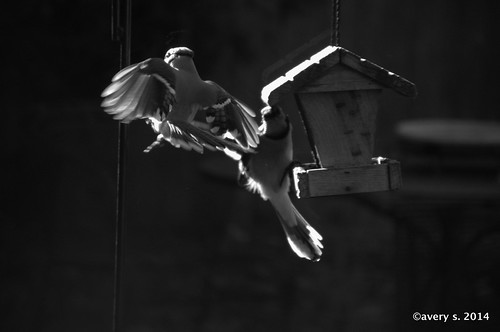
Dark-eyed Juncos and White-throated Sparrows are pouring into my area in ridiculous numbers, bringing my backyard count from none to ten in just over two days. Three Blue Jays have been hanging around and taking the peanuts I feed them. Black-capped Chickadees are coming almost every day, a female Downy Woodpecker came in yesterday, and a White-breasted Nuthatch was hitching up and down some spruce trees in my yard yesterday. Finches, both House and Purple, have been coming regularly as well.

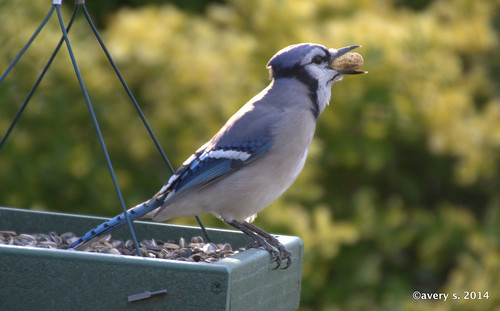
Blue Jay

Starting around now, most of my spare time during daylight when I am not birding is spent photographing birds at the feeders. I hang out with either my DSLR or my digiscoping setup and shoot through holes in the anti-window collision screen on my picture window.

What happens when I get bored
Another thing I like to play with in winter is my WINGSCAPES BirdCam Pro. This camera is automatically motion activated by any movement on the feeder it is aimed at, and I have captured some great shots with it. Mine is clamped to a pole several feet from my tray feeder.

And so now I'll stop talking and show you what you've been wanting to see: the pictures. Enjoy!

Northern Cardinal taken with WINGSAPES Birdcam Pro


Blue Jay with Birdcam Pro


2-DSC_0098
Blue Jay Fight


1-DSC_0057
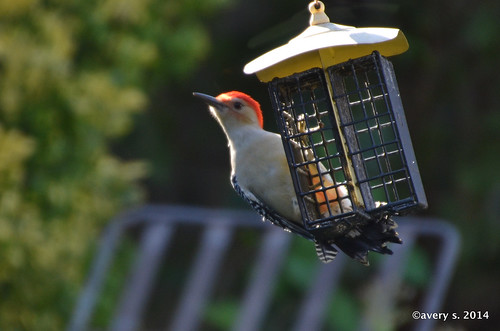
Red-bellied Woodpecker


3-DSC_0106
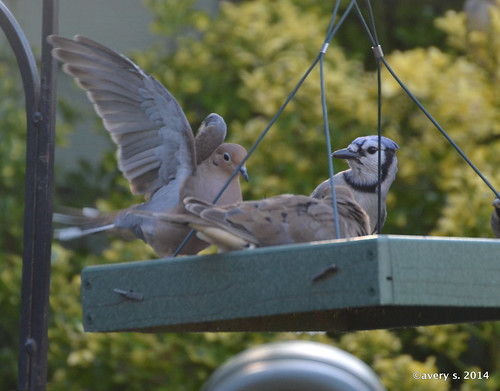
Blue Jay and Mourning Doves


4-DSC_0012
"I WILL swallow this peanut..."

Monday, September 22, 2014

New York Birder's Conference 2014 and Ithaca Birding

As I write this, I have just arrived back home from five wonderful days birding and attending NYSOA'S annual New York Birder's Conference at the Cornell Lab of Ornithology in Ithaca, NY.  I wish I could have written daily updates from Ithaca but this was unfortunately not possible. To catch up, I shall now attempt to give a brief summary of each day.


Day 1
Wednesday, September 17

My first full day in Ithaca was rather uneventful. I was not able to do much birding as my father had a business event for much of the day, but when he returned, I did manage to get over to Stewart Park, a major hotspot, for a little while. Stewart Park looks out over Cayuga Lake, the largest of the five Finger Lakes. The scenery was beautiful, but the place was oddly devoid of birds. The highlights of this quick trip were Belted Kingfisher and Common Merganser. Other more common birds included Mallard, Canada Goose, Ring-billed and Herring Gull, American Crow, and Double-crested Cormorant.

Cayuga Lake, as seen from Stewart Park

Day 2
Thursday, September 18

Thursday, my only free day for birding and nothing but birding, was very busy. The first stop was the Freese Road Community Gardens, a community garden run by Cornell Cooperative Extension. Parts of these gardens are overgrown with wildflowers and tall grasses, making it great for sparrows and the like in fall. Arriving there, I found the flowers to also be very attractive to butterflies, and I observed several different species there, including Clouded Sulphur and Eastern Tailed-Blue.

Birds, too were abundant, but it was somewhat frustrating the way the kept popping up and flying away to the opposite side of the field, then waiting till I got over there to fly back to the other end. But I got good looks at Song and Lincoln's Sparrows and American Goldfinches. American Crows were also present. 

Clouded Sulphur

Lincoln's Sparrow

American Goldfinch

I made a brief stop at the Johnson Visitor Center of the Cornell Lab of Ornithology, and then it was on to the Fuertes Sanctuary, which is a bird sanctuary named after famed bird artist and Ithaca native Louis Agassiz Fuertes. Here, too, birds abounded; a list of some of the species I observed there include Red-eyed Vireo, Scarlet Tanager, Carolina Wren, Belted Kingfisher, Great Blue Heron, Turkey Vulture, Black-capped Chickadee and Downy Woodpecker.


Ithaca Falls, another location I visited on Thursday


Day 3
Friday, September 19

Friday marked the beginning of the New York State Ornithological Association (NYSOA) conference, hosted this year by the Cayuga Bird Club. It was also the day I got to bird a place I had heard so many great things about, the Sapsucker Woods Sanctuary. The Sapsucker Woods Sanctuary, or simply Sapsucker to the locals, is situated behind the world-famous Cornell Lab of Ornithology. Some notable birds observed there included the sanctuary's namesake, Yellow-bellied Sapsucker, Eastern Phoebe, Cedar Waxwing, Great Blue Heron, Belted Kingfisher and Wood Duck. There was even a Mallard x American Black Duck Hybrid, which, appropriately enough, looked like a combination between a Mallard and Black Duck. 

Sapsucker Woods Pond

The Cornell Lab of Ornithology

Great Blue Heron

That night, I got to go to a reception and some other events at the lab. These other invents included a presentation on Cornell's website All About Birds, a look at a display of commemorative Passenger Pigeon Artwork and the personal study of Louis Agassiz Fuertes, and a behind-the-scenes tour of the lab and the Macaulay Library.


The originals by Louis Agassiz Fuertes

Passenger Pigeon by Charlie Harper

Friday was also the day I finally saw Big Red, one of the Cornell Hawks. Two Red-tailed Hawks, nicknamed Big Red and Ezra, have nested on the light towers at the Cornell Athletic field for many years now. Thanks to the Lab of Ornithology, viewers around the world have been able to watch inside their nest on a livestreaming cam. I have watched for two years, and by around the second week of my first year I was helplessly addicted. 

Big Red

Cornell Hawk Cams

Day 4
Saturday, September 20

Day four was, unfortunately, not a day of birding. It was a day of sitting inside a conference center listening to fascinating talks about birds, including one extremely intriguing presenation by Bridget Strutchbury on migration tracking in Purple Martins and Wood Thrushes. I also got to hang out with some other members of the New York State Young Birder's Club (NYSYBC), where those of us who had not traveled to far-flung (at least from New York) locations to bird where awed by photos and stories from those who had.

Day 5
Sunday, September 21

Pack up, get in the car, and go. After an eight-hour drive through New York City traffic, it was done. It was, though, a remarkable trip, one that I will most likely always remember.