Monday, October 5, 2015

NYSOA Conference 2015: Clearing Out Nemesis Birds

As I write, I have just returned from Albany, New York, where the 68th annual New York Birder's Conference, hosted by the New York State Ornithological Association (NYSOA) and the Hudson-Mohawk Bird Club, was held. In this post, I will not attempt to summarize each workshop and presentation, but rather I will summarize for your each birding trip I made.  Let's start on Day 1.

Day 1: October 2

I went to a trip led by a Hudson-Mohawk Bird Club member at the Albany Pine Bush. The Pine Bush is rare in that it is an inland pine barren, filled with pitch pine and scrub oak. Unfortunately on this day, it was not so full of birds. I got no pictures, but two lifers. The first was a Black Vulture--actually, three of them--soaring over the parking lot. The second was an Eastern Towhee, a bird that has artfully avoided me on Long Island. I also got a life mammal--Red Squirrel. 

Day 2: October 3

Unfortunately, the first stop of the day, Vischer Ferry Wildlife Preserve, was also largely dead. A flock of Yellow-rumped Warblers flitted through the woods, as did a Ruby-crowned Kinglet and a single Blue-headed Vireo. Teals of both species Blue-winged Teal and Green-winged Teal--were in the water with some Canada Geese.

My only shot of a Ruby-crowned Kinglet

The second stop of the day was unassuming. Ann Lee Pond is a small pond surrounded by woods near Albany International Airport. This pond was low down on the list of places to go birding, and eBird data did not look very promising. However, I noticed a single Eastern Phoebe hawking insects from a fencepost the moment we pulled in. 

Moments later, giving an unmistakable "kuk-kuk-kuk" call and flying with a distinctive bounding flight, a PILEATED WOODPECKER came swooping over the field and into the woods. As this is a bird that almost never comes downstate, I enthusiastically chased it across a road, where I finally got fantastic looks of the bird clinging to a telephone pole.

PILEATED WOODPECKER!

On the way to this woodpecker, I encountered more birds: a Tennessee Warbler, hopping about in a tree, a Northern Flicker in another field with White-throated Sparrows, and even two Eastern Bluebirds, their rusty breasts blending with the autumn tones of the turning leaves. 

Isn't this Eastern Bluebird pretty?
Curiously, the pond itself was mostly uninhabited. A single Belted Kingfisher swooped to and fro, while Song Sparrows and the aforementioned Yellow-rumped Warblers foraged in the brush, keeping a good distance from some extremely bright Blue Jays. 

Day 3: October 4

Actually, I didn't go birding on Day 3. I drove home--or actually, I rode home, as I cannot yet drive. But here's an amusing game to play on long drives--Count the Roadside Wildlife (watch out if you are driving alone--you should probably be concentrating on the road). Here's my wildlife list for the drive from Albany County to Nassau County.

(Note: I even saw a life bird on the drive home! I've put this in boldface.)

(Another note: I saw a lot of groundhogs. I've put the exact number, in fact). 

The Wildlife List

Bald Eagle
Blue Jay
Clouded Sulphur
Cabbage White
Groundhog (17)
American Crow
Rock Pigeon
White-tailed Deer
Turkey Vulture
Red-tailed Hawk
Mourning Dove
European Starling
Eastern Grey Squirrel
Northern Raccoon (dead)
Ring-billed Gull
House Sparrow
Herring Gull
Canada Goose
Turtle sp.
Great Egret
Monarch
Common Grackle
Northern Mockingbird
American Robin

That's 24 species. A great trip--made better by Count the Roadside Wildlife.

Groundhog


Sunday, July 19, 2015

The Whatchamacallit Bird

That title got your attention, didn't it?

I say "The Watchamacallit Bird" because to many people, this bird's name is really hard to pronounce. What everyone can agree about, though, is that a week ago, a RED PHALAROPE turned up at Jones Beach, which is really not where it's supposed to be at all. Luckily, the bird stuck around for a while, and I went to chase it eight days after it first showed up.

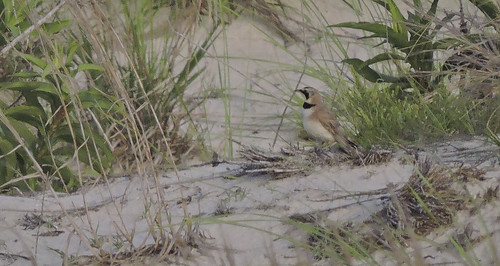
I knew I was in for a good evening (you get to the beach really early or really late so you don't have to pay) when the first bird I saw upon pulling into the parking lot was a small gathering of Horned Larks chasing each other around the dunes. As you may recall, I spent a lot of time at Jones Beach in the winter trying in vain to see just one Horned Lark. Seeing them in full breeding splendor, calling and engaging in aerial duels was quite a sight.
Horned Lark
Horned Lark takes a break from fighting


We (my parents and I) set off into the dunes, discovered that we were going in precisely the wrong direction, came back to the parking lot, and set off in the right direction.

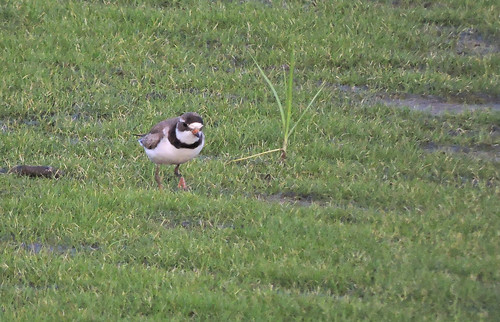
We did, in fact, find the ponds where the bird had been seen. On these ponds, there were many shorebirds. The water had mostly dried up, leaving expanses of flats, which were now covered liberally in scores of Least and Semipalmated Sandpipers, with Killdeer running to and fro and Semipalmated Plovers tapping the ground with their feet to lure insects to the surface. Overhead, Short-billed Dowitchers wheeled into a spiraling descent to the flats.
Semipalmated Plover
Semipalmated Plover


Common Terns were flying overhead, and with them were their smaller, rare counterparts, the Least Terns. With their white wings flashing over our heads, we walked on, checking each mudflat for a red bird with a yellow bill. 

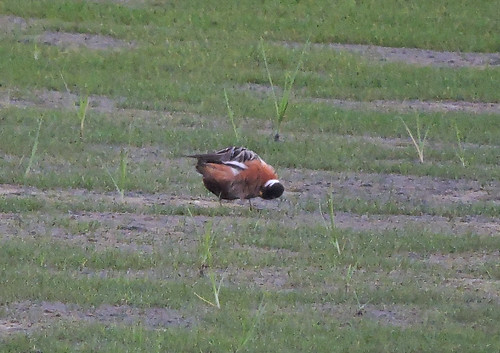
Finally, we reached a photography blind overlooking the pond where the phalarope had been discovered. I scanned it quickly with binoculars, and in the dimming light, found a rusty red bird with all the distinguishing characteristics of it's species. This small bird was, in fact, the RED PHALAROPE that had caused such stir among birders in New York. 

Truly, it's fame was well-earned. It was a breeding-plumaged female, meaning it was really beautiful. It's overall color was a bright orangish crimson, but close inspection with a scope revealed a black back streaked with white and a bright white patch on the cheek, accented by a bright yellow bill with which it probed in the mud. I hadn't the faintest idea what the bird was doing there, but it seemed perfectly at home, despite standing out visually from the browns of the other shorebirds. This bird's name, by the way, is pronounced FAL-A-ROPE. I have no idea how it got that name, but somehow it seemed to fit.
Red Phalarope
RED PHALAROPE!


We decided to finish up the day at the Coast Guard Station. Unfortunately it was high tide, but a flock of Sanderlings scurried back and forth, chasing the waves. Here's a tip: Sanderlings have no hind toe, so if you see a Sanderling with a hind toe, start to reconsider your ID. Using this method, I pulled two Semipalmated Sandpipers out of the flock.

The Sanderlings soon departed, as did the sun. It was a fine way to end the day, as it was necessary to leave the American Oystercatchers and Laughing Gulls that lingered and head back home.

But shorebird season is just beginning, and you can bet there's more to come.


Saturday, June 27, 2015

Terns Terns Terns

There is a place on Long Island called Nickerson Beach. In summer, birders and photographers flock there, drawn by the large colony of nesting Common Terns, as well as oystercatchers, skimmers, and various other cool things like that.

Nickerson Beach is best summed up in photos, as no written account of a visit can really attempt to capture the essence of the experience. Therefore, I choose to present you with some of my better photos from my recent visit to Nickerson. Enjoy.


This Common Tern is sitting on eggs.

The birds at Nickerson don't seem to be phased much by photographers
anymore.
Ironic that by far the best flight shot I took that day was with a  135mm
lens.

As they say, half of photography is luck. This oystercatcher took off as
I hit the shutter.

Only at Nickerson Beach.

Baby Terns!


Thursday, June 11, 2015

A Review: Merlin


Finally, here's the tool non-birder's have been asking about for years: a tool that allows a user to upload an image of a bird for instant computer identification. It's called Merlin, and it's from the Cornell Lab of Ornithology.

I tested Merlin with some clear, easy shots, and then threw some harder ones at it:


As you can see, Merlin has not yet mastered the very fine points of identification. A fine human birder would take note of the orangish-red bill and legs plus pale primaries and put that together to get Forster's Tern, rather than Common Tern, which has darker primaries and a red bill and legs.

Let's take a look at some of the harder photos I threw at Merlin and how it did on them. 


Hooded Merganser--Wrong

Long-tailed Duck--CORRECT


Least Sandpiper--CORRECT

Wood Duck--CORRECT (the correct answer is the third one listed)

Sunday, May 17, 2015

NYSYBC Big Day

If you have been reading this blog, you've probably figured out that I'm an active member of the New York State Young Birder's Club (NYSYBC). Today, myself and fellow member Noam K. joined forces for a joint Big Day in order to raise money for the club's scholarship program.

Our first stop was Forest Park, a spot you'll remember from last spring as being a great spot. Before diving into the park, however, Noam and I paused to get his list on paper. You see, Noam had visited Prospect Park in Brooklyn earlier in the morning to give us more coverage, and he had already seen 26 species, which gave us 26 less species to worry about locating later on.

Arriving at the Waterhole, a small, often flooded part of the park, we found a party of birders consisting of almost every prominent birder in the region. This was a great advantage: more eyes deliver more birds. This quickly proved true as we added Northern Parula, Black-throated Blue, Chestnut-sided, Magnolia and Blackpoll warblers. A Scarlet Tanager followed soon thereafter. A quick jaunt into the woods behind the Waterhole provided Hermit Thrush, Veery, and Thrush Sp., which doesn't count. Curiously enough, two Laughing Gulls flew over.

There was one warbler in particular that I had been hoping for, and my wish was granted when a small brown bird hopped into a birdbath, causing the excited response of "Worm-eating Warbler!" Unfortunately, our admiration of this bird was nearly ruined by a group of tourists who were happy to see the Worm-eating by positioning themselves in front of other people so only they could see, yelling and waving their arms about in a seeming attempt to scare the bird away, and then acting like it was everyone else who was rude.

Worm-eating Warbler

Our next stop was not really a stop, but a drive-by bird. And it did indeed prove a drive by bird, as we stopped for less than half and hour in order to add Monk Parakeets breeding on telephone poles to our list. However, we also added a Double-crested Cormorant and a Turkey Vulture, thanks to our enthusiastic parents, who spotted the vulture.

Monk Parakeet

And then, after lunch, it was on to the stop that had the potential to make the day, or break it: Jamaica Bay Wildlife Refuge. Here, we had hopes for a Bar-tailed Godwit that had been seen the day before, but it did not show. However, we did run into the considerate and helpful Steve Walter, who helped us to get a host of other shorebirds, including...

  • Semipalmated Plover
  • Ruddy Turnstone
  • Red Knot
  • Short-billed Dowitcher
  • American Oystercatcher
  • Black-bellied Plover
And some other birds that like water, such as...
  • Forster's Tern
  • Great Black-backed Gull
  • Least Tern
  • Great Egret
  • Snowy Egret
  • Great Blue Heron
  • Yellow-crowned Night-heron
  • Brant
Another thing about Jamaica Bay: swallows. Specifically, Tree Swallows. The Tree Swallows at Jamaica Bay are the most ridiculous thing you may see for a while. Nesting Tree Swallows! Fighting Tree Swallows! Almost-crashing-into-you Tree Swallows!

Tree Swallows


There actually at least three shorebird species in this picture. If you can find
them, more power to you.

At this point, we decided we were all pretty tired and had better be getting home soon. We took a walk around Big John's Pond at Jamaica Bay, hoping for a Barn Owl (we didn't get it) and then finished up our day together on a beach north of the East Pond.

But after leaving Noam, I was heading by myself to Alley Pond to see if I could fill in a few holes in our list. While I didn't get the songbirds we'd missed, I did pick up the Least Sandpiper that was too far out for a positive call at Jamaica, as well as the Spotted Sandpiper we had been running back and forth for at the same location. 

In all, it was a fun and successful day, despite our misses. Our final number was sixty-eight, which wasn't half bad considering that this year's migration has not exactly been the most spectacular. Here's our checklist, along with some of my other photos. Enjoy!


Semipalmated Plovers

Yellow Warbler

Least Sandpiper

NOTE: though I used the World Series of Birding Checklist, our Big Day had no relation to the World Series. Their checklist was used only because it is comprehensive, covers the Northeastern US and is small and easy to carry.


Monday, May 11, 2015

The Hawks of 5th Avenue

If you have not been living in a small hole many feet under the ground, you have probably heard about the famous Red-tailed Hawks nesting on an apartment building on 5th Avenue and 74th Street in New York. I hesitate to say the "Pale Male nest" due to this article. However, regardless of the male hawks's identity, I had an opportunity to go and observe these well-known birds from the famous Hawk Bench, the bench across from the nest in Central Park itself, where numerous scenes from the movie The Legend of Pale Male were shot.

So, enjoy the pictures and video!


The male hawk (I believe)

The female (I believe) carrying nesting material towards 5th Avenue

Mom with a hawklet

The view from the hawk bench

Mom and Hawklet Portrait I

Mom and Hawklets Portrait II (got two chicks in the same shot this
time, missed the third)

Mom and Hawklet Portrait III

Mom Solo Portrait 


Thursday, April 30, 2015

eBird Breeding Codes

Hey, anyone ever notice that little thing on eBird that says "add breeding code"?


                            Screen Shot 2015-04-30 at 12.47.02 PM

Really, don't just ignore it. Instead, take advantage of it. Breeding codes provide scientists with valuable information about when and where birds start to exhibit behaviors associated with breeding.

To add breeding codes to your checklist, simply click on the breeding code button and click the drop-down menu. Then, select the most appropriate code.


Screen Shot 2015-04-29 at 4.46.19 PM

Take a look at this checklist I submitted a few days ago. Since the Song Sparrows in question were only singing, the code I submitted was S Possible--Singing male

Very easy, very fun, and very important to add to your checklists, especially at this time of year! To read more about breeding codes, go here.


Saturday, April 11, 2015

Hempstead Lake--Early Spring Migrants

Early April, really, is the beginning of spring migration. Warblers have not yet begun to invade most of the United States, but there are a few early migrants: phoebes, Chipping Sparrows, and perhaps two or three species of warblers.

Around where I am, the place to go at this time of year is Hempstead Lake State Park. It boasts woods (good for migrants) as well as large bodies of water (good for lingering waterfowl). It also happens to be right on the way to the violin shop where I get my violin checked over in the early spring, so what harm could it do to stop and take a look around?

The first bird of interest was an Osprey over the lake, seen from the car as we pulled into the parking lot. I was soon distracted from the Osprey by something that was not, in fact, a bird at all: a Mourning Cloak butterfly, the first butterfly to emerge here in New York, often coming out as early as late February. This one seemed quite tame and allowed me to approach to the point where my camera could no longer focus. Two male Downy Woodpeckers fought in the trees.

Mourning Cloak


Down in the woods by the South Pond, a pair of Tufted Titmice bounced around and looked cute in the brush while Common Grackles and Red-winged Blackbirds bathed in a stream. Here at the beginning of spring, I could really see the advantage it is to have studied your bird songs: by ear alone, I picked out a Belted Kingfisher, White-throated Sparrow, Song Sparrow, Northern Cardinal and Red-bellied Woodpecker. Another Osprey flew directly overhead, and a Great Blue Heron made an awkward landing by the edge of the pond.

Looking closer at the surface of the water, I could see dozens of acrobatic Tree Swallows, my first-of-season, skimming over the pond, hunting bugs. In their midst, a larger creature emerged--a Beaver swimming towards the shore. Some Red-eared Sliders (turtles) basked on a log.

Tree Swallows. Terrible picture, I know, but you try catching a bird
moving that fast on camera.

Hello, Mr. Beaver!

At this point, I was happy with the birds and other animals we were getting, but I was missing three sought-after and celebrated migrants--Eastern Phoebe, Palm Warbler and Pine Warbler. Although the phoebe never showed, the other two were testaments to the importance of birding by ear.

As we were walking back towards the car, I heard an unmistakable trill. I confirmed it with a recording pulled up on my dad's phone--it was, indeed, a Pine Warbler. Having heard it, I could count it for a list, an eBird checklist, whatever, but I wanted to see it too. After hearing the song several more times, I saw an unmistakable Pine Warbler flitting to and fro next to a Chipping Sparrow in some brush. It flew back into the woods with a friend. Chasing it, I came upon another, and another, and then another. Just as I thought I was seeing six Pine Warblers, I gave a closer inspection to one of them and realized that it was in fact a Palm Warbler, one of several that were ducking in and out of the brush. 


Pine Warbler

Moments later, I turned to see my mother gesturing at me, pointing at something in a pile of fallen logs. I pished, and the bird popped into view for a moment, but only in silhouette. It was a wren, some sort of very tiny wren.

In a second, the bird popped up onto a log and showed itself. It was a Winter Wren! It was just a tad late, Winter Wrens only truly become uncommon on Long Island in May. I had come in search of spring migrants but was also reminded that winter was only just past.

It was 3:15. I had been birding over an hour, and an hour was as long as you were allowed to stay in the parking lot (if you had paid when I did). Thus, I headed back to the car, got in, and left the warblers behind there at Hempstead Lake.

Left the warblers behind--for now.

Osprey

Pine Warbler


Thursday, March 19, 2015

SSS: Seventh Species of Sparrow


Today, March 19, 2015, I have officially ticked the Seventh Species of Sparrow in my backyard on Long Island, NY.

Actually, I didn't find the bird myself, my mom saw it. She subsequently woke me up and showed me a picture of it, saying that "there's a bird at the feeders I don't recognize." I, in turn, bolted downstairs faster than I believe I have ever moved from the bed to the other side of the room. Upon arrival at the window, the bird was gone.

Hours later, I was still looking for the bird. I had seen five or six Dark-eyed Junco, White-throated Sparrow and Song Sparrow, but the sought-after Seventh Sparrow was still gone.

Until I spied a small reddish fellow under one of the feeders. Upon inspection, the sparrow in question proved to be the FOX SPARROW, the Seventh Species of Sparrow (SSS) for my backyard. Not only that, but despite many hours waiting for Fox Sparrows to show themselves at the feeding station of Forest Park in Queens, I had never seen one and had thus developed a nemesis relationship with the bird. So not only was the Fox the Seventh Species of Sparrow for my backyard, it was another nemesis eliminated and my personal ninth sparrow species (I have seen Lincoln's and Swamp outside my yard.)

With that, take a look at the pictures, and may you be successful in your search for Sparrow #7.

NOTE: I do not include House Sparrow on my yard sparrow list. This is because they are not true sparrows, they are in fact weaverbirds from Europe that were introduced to North America. I only count native sparrows on my yard sparrow list.

Talk about camouflage.

There is no question about this bird's ID.

My, what pretty streaking you have!


Sunday, March 8, 2015

Tidbits on Spring and My Method for Learning Bird Song

As I write, it is March 8, and here in New York, we are entering a series of warm days that may well mark the official entrance of spring. These warm days have been proceeded by various more subtle clues, such as various birds like the Northern Cardinal and Song Sparrow beginning to sing (we'll speak more about that in a moment) and showing other early courtship behaviors. However, many people do not really notice the entrance of spring until the first really warm days.

Birders most especially have strong feelings about spring. These feelings could be diagnosed as Anxious for the Coming of Migrants Disorder, or simply ACMD. Symptoms include, at least for me, obsessive flipping through of The Warbler Guide, constantly having hallucinations of warblers and the inability to think about anything other than spring migration.

Actually, many people feel a yearning for spring, and perhaps what birders feel is just a more intense version of the same thing. Allow me to quote Kenneth Grahame in the immortal "Wind in the Willows":

The Mole had been working very hard all the morning, spring- cleaning his little home. First with brooms, then with dusters; then on ladders and steps and chairs, with a brush and a pail of whitewash; till he had dust in his throat and eyes, and splashes of whitewash all over his black fur, and an aching back and weary arms. Spring was moving in the air above and in the earth below and around him, penetrating even his dark and lowly little house with its spirit of divine discontent and longing. It was small wonder, then, that he suddenly flung down his brush on the floor, said "Bother!" and "O blow!" and also "Hang spring-cleaning!" and bolted out of the house without even waiting to put on his coat. Something up above was calling him imperiously, and he made for the steep little tunnel which answered in his case to the gravelled carriage-drive owned by animals whose residences are nearer to the sun and air. So he scraped and scratched and scrabbled and scrooged and then he scrooged again and scrabbled and scratched and scraped, working busily with his little paws and muttering to himself, `Up we go! Up we go!' till at last, pop! his snout came out into the sunlight, and he found himself rolling in the warm grass of a great meadow. 

"This is fine!" he said to himself. "This is better than whitewashing!" The sunshine struck hot on his fur, soft breezes caressed his heated brow, and after the seclusion of the cellarage he had lived in so long the carol of happy birds fell on his dulled hearing almost like a shout. Jumping off all his four legs at once, in the joy of living and the delight of spring without its cleaning, he pursued his way across the meadow till he reached the hedge on the further side.

As you can see, a sort of spring restlessness is well-documented in classic literature. Look at Henry David Thoreau and his "Journal", a diary of his time at Walden Pond. In it, he recorded the exact leafing and blooming dates of many plants and other signs of spring. This data was then used for scientific purposes many years later.

Inspired by this, I have been keeping records this year of my observations on the coming of spring, noting the first dates I heard which birds singing and also the temperature, precipitation, etc. (no flowers have bloomed yet in my area, but I will note when they do). Perhaps one day my notes will be used for scientific purposes as well.

~

Let's return to "The Wind in the Willows" again, specifically to this passage:

"This is fine!" he said to himself. "This is better than whitewashing!" The sunshine struck hot on his fur, soft breezes caressed his heated brow, and after the seclusion of the cellarage he had lived in so long the carol of happy birds fell on his dulled hearing almost like a shout.

The carol of happy birds! The singing of birds is perhaps the most welcome characteristic of spring, second to the flowers blooming.

But it's more than just a happy sound. Birders can and do use song as a major identification key; in many situations it is even more important than appearance. Don't believe me? You try identifying a tiny bird flitting around at the top of a tall tree based on whether or not it has wing bars! But just wait for the bird to sing and you could have the answer without ever looking up.

In "The Verb: To Bird", Peter Cashwell argues that knowing songs and calls is the line that separates causal bird watchers from hardcore birders. The prospect of learning songs seems to put off a lot of people. However, fear not: let me present my method.

What I've done is put all the songs of all the Northeastern Spring Migrants on my iPod. Then, I put a few common ones in a playlist and listen to them, while looking at the picture of the bird (to associate the bird's appearance with it's song in my head) and the spectrograms found in "The Warbler Guide". Then, I play through them and try to name them without looking. As I learn them, I add more.

Some of the warbler songs in my playlist


Descriptions of songs can be very helpful! If you
don't agree, listen to this recording of a Blackpoll
and see if it sounds like the description.
Good luck with learning songs! It will greatly increase your birding success this spring.


Saturday, February 28, 2015

Jones Beach: how to miss the birds you came for

Today, I went to Jones Beach and missed my nemesis birds again.

In fairness, I also saw some other nice birds. Once again forgetting fairness, I really need to see my nemesis birds and Jones Beach is where they are. But on to what I did see.

Arriving at the Coast Guard Station, I instantly found a flock of Bufflehead hanging out among the pilings and some Brant on the grass. Some little birds in the brush caused a stir when I imagined they could be Horned Larks, my #1 Nemesis, but they proved to be Song Sparrows. However, a close scan revealed a Yellow-rumped Warbler, a new addition to my year list.

The Coast Guard Station
Out in the bay, I counted twenty Buffleheads, in addition to three Red-breasted Mergansers, two Horned Grebes and an American Wigeon. Further out, I found a Common Loon and then promptly lost it as it dove; while trying to re-find it (which I eventually did), I instead found some Long-tailed Ducks. There was a Killdeer in the grass next to the bathrooms with some Ring-billed and Herring Gulls.

I moved on, driving down the loop to the West End II parking lot. There was nothing in the actual parking lot or surrounding territory. But on the side of the road there were some American Tree and Song Sparrows, as well as a very close-up Northern Flicker which unfortunately flushed before I could take advantage of the great photo opportunity.

American Tree (bottom and top right)  and Song (top) Sparrows.

The final stop of the day was parking field 10, a known hotspot for seals. Unfortunately, my parents drove literally to the next county looking for it, due to the lack of a sign indicating the presence of a parking field. By the time we turned around and got there, it was getting late, but there were a few Red-breasted Mergansers hanging around, in addition to more Brant, Bufflehead and some Lesser Scaup. All three gull species common here in the winter were present: Ring-billed, Herring and Great Black-backed.

The last treat of the day was not, in fact, a bird. It was watching the wonderful sunset, an experience everyone should have at one point in their life or another. Often, after a day birding, watching the sunset is a great way to either end a fantastic day or let go of what you missed and relax. And so it was.

Now that I've not gotten hung up on what I didn't see and appreciated the birds I did, I will go get my nemesis birds! Just not today.


Lesser Scaup

Great Black-backed Gull in the Sunset

             
To see the other video from the day, go here.


The sunset